Pages

Showing posts with label writing. Show all posts

Wednesday, May 22, 2013

Writing Realistically Unrealistic Dialogue


When I was a young lad kid, Dawson's Creek was the big cheese. (sidenote: I can't believe it's been off the air for a decade!) The main criticism of the show was that teenagers do not talk like these characters in real life. Dawson, Pacey, Joey, and Jen were too eloquent, using vocabulary that had been deep-fried in SAT Prep books. It was unrealistic. It's true that the characters didn't sound like real teens, but the dialogue was still one of my favorite parts of the show.


I love writing dialogue, and I love reading/hearing great dialogue. Snappy banter, witty retorts, juicy monologues. Yes, please, and thank you. The main purposes of dialogue is either to a) get out plot b) reveal character traits c) expose tension. Lots of writers use workmanlike dialogue: it gets the job done without being distracting. And usually the dialogue is enjoyable to read, even sometimes funny. But then there are writers who go the stylized route. Aaron Sorkin, Quentin Tarantino, Kevin Williamson, Kevin Smith, Shonda Rhimes. Their dialogue is heightened and no way would ever get confused with realism.
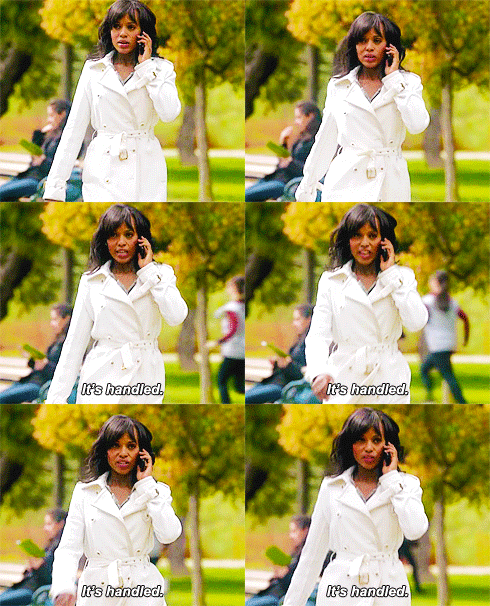
Olivia Pope in SCANDAL, aka the best show you're not watching with amazing dialogue and trench coats.

High school films especially can get away with this. Some of my favorites -- 10 Things I Hate About You, Clueless, Heathers, Easy A, Juno, Bring It On, Brick -- feature characters who sound nothing like real teens. They exchange witty banter, infused with unique vernacular, rapid pop-culture references, and intelligence. Again, I'm salivating here. The dialogue is amazing in these films. When I'm reading a book/watching a movie, I don't want to hear realistic teen talk. I am entering a fictional world filled with fictional characters. How they speak should be just as creative as everything else in their world. That's part of the fun!


10 Things I Hate About You is boss when it comes to this. The dialogue in that movie, especially for Kat, was stuffed with sharp one-liners, delicious back-and-forth, and hyper-articulate characters. The film had the sound of Shakespearean language transplanted into high school. (Seriously, I think my SAT verbal scores improved from everything I watched growing up.)

Some choice quotes:
"Has the fact that you're completely psycho managed to escape your attention?"

"Can we, for two seconds, ignore the fact that you're severely unhinged and discuss my need for a night of teenage normalcy?"

"What is it with this chick? She have beer-flavored nipples?"

"Remove head from sphincter, then drive!" 

"People perceive you as somewhat.."
"Tempestuous?"
"'Heinous bitch' is the term used most often."

I could go on and on and on and on but yeah, teenagers (and most adults) do not talk this way. So why does it work? Why is this type of whip-smart chatter so prevalent in teen films without being distracting?

Because even though what they're saying is unrealistic, how they're acting is.  And that's the golden rule. The dialogue may be heightened, the plot may be miles from reality, but what characters are feeling and how they're acting must be relatable or else you'll lose your audience. The teens in Dawson's Creek may talk like Rhodes Scholars, but people watching could relate to them and understand the emotion they felt. If your character is talking in sonnets, sure, we'll go with you on that ride. But if his beloved girlfriend cheats on him with his best friend and he just shrugs it off, then we lose interest. Because that is unrealistic and will confuse/frustrate your reader. (note: unless he has a good reason to react the way he does that makes sense within the story and all that jazz, but this is just a broad example)

I believe that creating realistic, relatable characters with heightened, unrealistic dialogue makes the reader experience much more enjoyable. We read books for escape. Watching a show or movie where characters are like us but with better dialogue lets us live vicariously through them. Who doesn't wish they could have witty banter with friends and crushes?

Ok, some more witty banter for the road, courtesy of Easy A:

Woodchuck Todd: [in Woodchuck costume carrying head] Hey Olive.
Olive Penderghast: Oh my God! The illusion is shattered! This is exactly why they put you in the gas chamber if you take your head off at Disney World.
Woodchuck Todd: Actually I think they just, you know, they fire you. You're thinking of Disneyland. Disney World is much more liberal.
Olive Penderghast: Oh yeah! I always forget Disney World went blue in the last election.


How do you feel about dialogue? Are you delighted or distracted by overly articulate teens? 

Monday, April 8, 2013

Trunked Novels

It was recently announced that actor Jason Segel is going to be the latest celebrity to write a YA novel. What's interesting is that he's basing it on an unproduced screenplay he wrote when he was 21. I wonder how many authors, once they get published, return to trunked novels and ideas and try to make them shine.

From one Siegel/Segel to another, good luck! (photo via imdb.com)


I'm sure authors have been tempted. Your publisher is asking for a second novel in half the time you wrote the first one. And oh, look. Here's this completed novel that was subpar when I first wrote it, but that was before someone considered my work publishable. A little read-through and some spackle, and tada -- shiny new manuscript. Right?

Should trunked novels stay trunked?

There's a reason why a novel was trunked, and it wasn't because you had to get published first. Nobody wins by you trying to prove that everything you've ever written is worthy of getting published. I have two trunked novels. The first one is near and dear to my heart, and I gave up on it after four drafts. I always loved the writing in it, but something wasn't clicking storywise. I'll admit, though, once THE BREAK-UP ARTIST sold, I seriously considered polishing it up and sending it off to my agent. I even had a writer friend read it and give me notes -- notes that were nearly identical to the feedback I'd received years ago.

That's when I realized that this novel wasn't a failure. It was a moment in time, a point on my journey as a writer. The problems I saw in this novel I've since overcome on my next books. When I look back on my two trunked novels, I don't see failure. I see progress. I pinpointed where those books floundered and applied that moving forward. Trying to fix them up and make them publishable would diminish their value. You don't need to validate your trunked novels, your aborted attempts, your former SNI's. If you can learn and grow from those experiences, then they are all successes.

Don't go backward. Keep moving forward. If you want to have a career as a writer, you'll need to develop new ideas. If you are *seriously* attached to an old story, don't salvage the old manuscript. Use the idea and redraft from scratch. Make it your own, for the improved, wiser you.

Do you try to rework trunked novels? Have you recycled old ideas?

Thursday, December 27, 2012

Drafting: A Numbers Game

After reading Leign Ann Kopans's blog about Fast Drafting over at argyle central YA Misfits, I wanted to share my crazy strange method for writing first drafts. For me, it's all about the numbers. When I think about writing a book, I'm overwhelmed by the sheer size. Hundreds of pages! Thousands of words! All coming from me? I prefer to break one big book into lots of little sections.

[WARNING: I'm a bigtime plotter, so I don't think this method will apply to pantsers.]

For those fantasy and sci-fi writers who can churn out 100,000 words -- even writers who can reach 70,000 words -- I am in awe of you. I just can't write that much. I aim for my book to be 60,000 words. That's a solid length for contemporary YA.

1 book = 60,000 words

First, I create a chapter outline, breaking my story into chapters. I make myself create a minimum of 30 chapters. If the story needs more, fantastic! But 30 is an acceptable amount that falls within genre standards. So for my 60,000 book, each chapter will have to hit 2,000 words.

1 chapter = 2,000 words
I think I can do 2,000 words, but it still seems like a lot. So I break it down even further.

I create scenes within my chapters. Instead of each chapter consisting of 1 scene, I include multiple little scenes. The scenes don't have to be interconnected, but the final scene of a chapter should propel the story and make the reader want to keep reading. I aim to have 4 scenes within each chapter. I'll split big scenes in my head even if it's written as 1 scene in the book. For instance, if there's a big "party" scene where the MC talks with some friends then gets in a fight with her boyfriend, that may all happen in one scene, no break. But mentally, I'll count the friends part as 1 scene, and the boyfriend argument as another scene. So in a 2,000 word chapter, each scene needs to be 500 words.

1 scene = 500 words
I can do 500 words. That's manageable. That should take under an hour to write. But sometimes, 500 words can seem like a lot. There may not be enough going on to justify 500 words.

So I look at sentences. On average (based on my unofficial research), 5 sentences equals 100 words. And since it's a first draft, I allow myself to write longer, rambling sentences and break apart my contractions. One extra rambling sentence can net you 30 words. And if you're at 19,940 words, those 30 words can give you the motivation to get you to 20,000.

5 sentences = 100 words
We can all write 100 words. Scribble it on a notepad during a boring meeting, or on a short bus ride. Every little bit helps. I will finish this book 100 words at a time. Each 100 words gets me closer to that 500 word scene, which gets me closer to finishing that 2,000 word chapter.

Will writing this way produce beautifully crafted prose?
No! 

It's a first draft. My main goal is to get the words on the page, to get the story from beginning to end. Nobody said it had to be good. Thanks to overstuffing and stretching out the first few chapters, I usually manage to break 60,000 words, but barely. The words hardly come easily to me. In revisions, I cut the fat. It's better to have fat to work with than to try and create it.

Microsoft Word has the word count ticker at the bottom of the page, so I am forced to look at it. I can't not look at it. And for me, this works. It's a way to feed the analytical part of my brain while I'm being creative. I like to have something to obsess over accountability. This method may not work for you, and that's fine. But if you're a numbers person like myself, feel free to give it a shot!


Monday, October 22, 2012

It's Ok If You Don't NaNo


Nanowrimo is a week away and pretty much every writer I know has been talking about it. For those uninitiated, Nanowrimo = National Novel Writing Month = write a 50,000 word novel in November.

I am a huge proponent and supporter of this program. I have blogged about how getting words on the page is so important and how all writers Nano to some degree. As cool as Nano is, it's OK if you don't take part. This does not make you a loser or a failure or any less of a writer than people who participate. I love the online writer community, but I feel like there is this unspoken peer pressure to do Nanowrimo. It's easy to succumb to FOMO (fear of missing out) when you read blogpost after blogpost of writers gearing up for Nano. And it will get more omnipresent once November begins.

Confession: I have never partaken in Nanowrimo.

I first heard about it in fall 2009. I tried to participate that year. I'm a mega-plotter, and my outline has to be rock solid before I feel comfortable drafting. I also have to know my main character, get acquainted with him/her, figure out the voice. I can't just "jump" into writing -- that's just how I roll. I rushed to have my outline plotted, and on Nov 1, I dove in. I sat down to write and sputtered after 200 words. I had no idea what I was doing. I didn't have a feeling for the MC.

I was working around Nano's timeline, not mine.

Each year, I always say I'm going to Nano -- and I really want to -- but the timing never works out. I was going to Nano this year. I'd been working on my outline, but I found myself scrambling to meet the Nov 1 deadline. It's like a countdown clock that is ticking in my head. Do you ever find yourself typing horribly when someone is standing over your shoulder? That's how I was feeling this month. For some writers, Nano is great. It's that kick in the shorts they need to get started. But it's not one-size-fits-all. Maybe I'll start writing my book on 11/15, or 12/1, or 1/1. The point is, I will go by my own schedule.

And it's ok if you do, too.

Like I said, Nanowrimo is a wonderful event. But it's not for everyone. Don't feel ashamed or ostracized if you don't participate. Don't feel embarrassed that you couldn't get yourself all prepared to start writing at midnight November 1. There are 364 other days to start writing your book. You can still be a Nano cheerleader and a rock of support to other participants. And maybe you'll use the 30 days of Nanowrimo to perfect your outline, or finish a draft, or revise a draft. Or it will just be a countdown to Thanksgiving like it is for 99% of the world.

Whatever you do in November, make sure it's what is best for you.

Monday, September 24, 2012

How to Include Technology in Your Writing


Remember me?


Reading the Perks of Being a Wallflower was a blast from the past. The book takes place in 1991, before cell phones and computers. The characters make each other mixtapes and call each other on their family's landlines. It's easy to write around fashion and design fads, but technology has become its own beast. Constantly changing technology makes films and TV outdated instantly in a matter of years. (Anyone still use the T-mobile sidekick from The Devil Wears Prada?)

How the heck are you supposed to write a contemporary YA novel then?

You can't keep up with technology, especially with the 2-year lag time it can take books to get published. Think where we were 5 years ago. The iPhone just came out. The Motorola Razr and Myspace were huge. Think where we were 3 years ago. Nobody had iPads or Instagram. Teens are the most tech-savvy, so they'll notice any obsolete technology. Here are some Dos and Don'ts I try to follow when incorporating technology in my writing:

1) Don't get specific: Staying general will buy your book some time before the technology becomes obsolete. While specific products may change, the product categories will be around for a while.
  • If your characters are on a cell phone, don't say what kind it is. Just say they are using a phone. Don't even specify how they use it. For instance, "flip open" and "clap shut" imply flip phones, which are so mid-2000s. 
  • Don't elaborate on what type of computer your character uses. Desktop PCs are on their way out, and over time, even laptops will fade away in favor of tablets. 
  • For social networks, Facebook seems like it's here to stay, and it's so ingrained into our social lives that it's hard to ignore. However, just say that your characters are on Facebook, and if they must be on the site, only have them do basic, broad tasks like looking up people. Don't mention any nitty-gritty features or Facebook language because that is constantly changing, e.g. profiles are now timelines, fans are now likes.
  • Avoid mentioning specific web sites or web properties like Twitter, Instagram, Pinterest, even Words with Friends. Your characters can see something someone wrote online or posted online, but it's best to not mention where they saw it and what exactly they saw. Let your reader fill in those gaps him/herself.
  • I would avoid referencing DVDs, and even Netflix. Home entertainment is changing so rapidly. All you need to say is that she's watching a movie at home. Nobody cares about the specifics.
  • Technology may move fast, but not for everyone. Some people still use dial-up and a desktop computer. Approximately 85% of Americans have a cell phone, but that means that 15% still do not.
2) Do include technology when it's logical for characters: I've already ranted about characters using pay phones in YA. I haven't seen a pay phone in years. You can't avoid technology altogether, and trying to will look ridiculous. Your main character can't be the only person at her school without a cell phone. She can't listen to cassette tapes just because it's cool. However, you can get away with this if you provide a good enough reason -- she lost her phone, it got stolen, she's punished. In Thirteen Reasons Why, Hannah left behind a dozen cassette tapes, but at least Clay pointed out how old school that was, and how he had trouble finding a Walkman to play them on. It would've been strange if he just had a Walkman lying around like it was no big deal. Remember, for your readers today, CDs were popular when they were born, but they came of age in the era of MP3's.

3) Don't feel the need to rely heavily on technology: Yes, kids today are hooked to their gadgets. Get off my lawn! They communicate primarily through texting and online chatting; they're on their phones or computers constantly. But if you wrote your book like this, it would be kind of boring. Have characters talk face-to-face, even if kids wouldn't do that in real life. Do you ever notice how characters on TV shows are over each other's apartments all the time? Can't they have half of these conversations over the phone or via text? Nobody would watch a show like that. It's dramatic license, but we want to see characters interact in person. Books like Will Grayson, Will Grayson do a great job with turning Instant Messaging into compelling fiction, yet the most memorable and impactful scenes in that book are ones where characters have to face each other.

4) Don't let technology take over your story: This is the most important rule. Technology is forever changing, but emotions and conflicts are not. People read books for the characters and the story, not for the technological accuracy. Don't obsess over how to incorporate technology into your story. The Perks of Being a Wallflower takes place in 1991, but that didn't stop me from enjoying it. The characters in that book felt real and relatable, even if they didn't have cell phones. Holden Caulfield is still a wildly popular character, even though he never had a Facebook profile. Readers aren't going to throw your book out if your protagonist doesn't have a smartphone.

What are your rules of thumb for including technology in your writing?

Tuesday, June 12, 2012

Writing is Work - Not Pleasure

Happy June! I hope you all are enjoying some of the longest days of the year. It's been light out until 9 p.m. here recently!

I am nine days a week late, but I hit my 1-year blogversary! I can't believe it's been a year of blogging, and I'm proud of myself for keeping up a somewhat consistent pace. I give credit to the prolific bloggers out there who generate content multiple times a week. Expanding your network. Coming up with post ideas. Blogging's hard work! And so is writing.

Over the past few weeks, I've been changing my attitude towards writing. Maybe it's an attitude I've always had but have tucked away, not wanting to admit. I realized that writing is work -- hard work -- and not pleasure. It's not meant to be fun. And that's where I think many aspiring writers stumble.

Some people who are interested in writing think of it as a fun side hobby, a creative release in their lives. They look forward to that time of day when they can sit down and write. But when they do get to writing, and are blocked or the words aren't flowing, they give up. That's because they have the wrong mindset. When you want to do something for pleasure, you don't expect it to be hard. Reading, watching TV, going to the beach. There's nothing difficult in those hobbies. Writing can be difficult, and it can catch people off guard. More intense hobbies like playing an instrument, arts and crafts projects, or crossword puzzles may require extra effort, but they don't have stakes. It's still low stress level. Most people aren't practicing guitar to try to snag a record deal. They aren't beading necklaces in order to start their own jewelry line. These are generalizations, but there are less people doing those hobbies with professional aspirations than there are writers who have hopes of book deals.

When I sit down to write, I have to remind myself that this may not be fun, especially when I edit. I need to stop setting up false expectations for myself that writing will always be a pleasurable escape. I am working, just like I would be at my job. Of course I enjoy writing or else I wouldn't stick with it, but that doesn't mean it will be fun all the time. It's just like any job. There are good days and bad days, but if you have a frustrating day at work, you aren't going to skip the rest of the week. You slug through it. The fun high of writing can wear off when you are deep into a project everyday. So now when I make time to write, I know that it's for work, not pleasure. I'm not duping myself any longer. It will be tough. It will be frustrating. But like anything that requires hard work, it will ultimately be rewarding.

What is your attitude when you approach writing?

Tuesday, May 29, 2012

The Multitasking Writer

I recently finished the second draft of my WIP and sent it off to readers. It was an awesome feeling knowing I had accomplished this. But it also put me in writing limbo. I was between drafts, stuck in a state of waiting. And because of my limbo, I slid into a writing lull as well. At first, I just breathe a sigh of relief that I finished. But then restlessness sets in: what should I work on next? should I start something new or wait until this WIP is completely done? Naturally, I fall for the Shiny New Idea in my head and begin brainstorming. I used to worry that focusing on a new idea would make me stop caring forget about my WIP. Shiny New Idea is 10X better than what I just wrote, I would tell myself. But 2012 is the Year of Finishing Stuff. And that means multitasking with my writing.


It seems a little difficult, juggling multiple projects. Different characters, different tones, different settings. But multitasking is what professional writers do. They're editing one book, promoting another, and drafting a third. When you're working with limited writing time or tight deadlines, the only way to get stuff done is to multitask. In 1992, Steven Spielberg was in post-production on Jurassic Park while he was filming Schindler's List. Nazis during the day; dinosaurs at night. Two movies that couldn't be any more dissimilar. But he multitasked and got it done. He did the same thing years later with War of the Worlds and Munich. In 1999, Robert Zemeckis was filming Cast Away starring Tom Hanks. He filmed all the before/after island scenes first, then took a long hiatus to allow Hanks to emaciate himself. Instead of spending that downtime lounging on his couch watching reruns of Wings, he filmed an entirely separate movie: supernatural thriller What Lies Beneath with Harrison Ford and Michelle Pfeiffer. Many TV actors also make good use of their summer hiatuses by squeezing in movie roles. Only a pro like Melissa McCarthy could go from Mike & Molly to Bridesmaids.

TV writers staffed on multiple series have to juggle different characters and plotlines. Chuck Lorre produces both Two and a Half Men and The Big Bang Theory. While tonally both shows are the same (laugh track comedies), the characters and comedic rhythms are not. Ryan Murphy wrote American Horror Story and Glee concurrently -- two shows nobody would ever group together.


It's ok to succumb to the Shiny New Idea. We're human. We crave new things. A Shiny New Idea can energize us, inspire us to jump back into writing. But it shouldn't take up all of our brainpower. We have to learn to juggle projects new and old. It's all about multitasking. On the bright side, if you can manage this, then you'll never be bored.

Tuesday, May 1, 2012

Good Dialogue is like Flirting

The best advice I ever read about writing was this: If the scene is about what the scene is about, then you're in deep sh*t. In other words, it's all about subtext. Without subtext, you have no book. Dialogue is where subtext is needed the most. And to write good dialogue, the characters must be flirting.

This doesn't mean that all your characters must be trying to jump each other's bones.


On the Nose is a popular expression when discussing bad dialogue. It means that the character is saying verbatim what the writer is trying to express. That equals bland dialogue. Nobody talks like that, and your readers won't enjoy it. For dialogue to snap, crackle, and pop, there must always be subtext. What's going on beneath the words. If what the character is thinking and what they're saying is the same, then there is no subtext, no hidden layer for the reader to relish. In other words, you're in deep sh*t.

We don't talk like this in real life when we're gabbing with our friends and family. We say what's on our mind. The main time when we immediately switch to talking with subtext is when we flirt. Have you ever seen two people flirt? On the surface, they are having a regular conversation. But their body language is having a different discussion, and it's all about sex. What they are talking about has very little to do with their objective. That's something to strive for in your dialogue.

Which scene is more entertaining to read:

"You're very pretty and I want to kiss you," Guy says. He runs his fingers down Girl's arm.
"You're also cute and I want to make out right now," Girl says. She blushes and interlocks her fingers in his.
They kiss.

Or...

"I heard that it rains in Seattle ten months out of the year," Guy says. He runs his fingers down Girl's arm.
She blushes and interlocks her fingers in his. "Doesn't it ever snow there?"
"I guess not."
"So no white Christmas for them."
"Sad but true."
They kiss.

Both scenes accomplish the same thing and have the same description. But which was more entertaining to read? The first conversation had no subtext. Their words and body language were in sync. In the second scenario, their conversation has nothing to do with what's going on between them, and yet it works. If this were just smalltalk, it would put readers to sleep. But here, talking about the weather only increases the tension, making for an exciting read.  

Not all scenes you write will be as exciting as a kiss scene, but that's not an excuse to write bland dialogue. If the scene is about what the scene is about, then you're in deep sh*t. Jot down what your characters' objectives and feelings are in the scene and write their dialogue as far from that as you can. Remember, we are creatures of contradiction. We push people away when we need them the most. We are cordial to people we loathe, and rude to the ones we love. Our friends' happiness can make us miserable. That's what makes us interesting.


Tuesday, April 10, 2012

Let's Write Crap!


Two weeks ago, I didn't do much writing of any kind. Not even blogging. I barely rewrote one chapter of my WIP. I would think about said chapter, make notes about said chapter, but when it came time to rewrite said chapter, barely anything came out. I rewrote it in fits and starts, deleting chunks and redoing it, inching my way through the chapter. Until Saturday, when I decided to go ahead and write crap.

Writing crap felt wonderful! I crapped my way through it. I knew what I was writing wasn't great, but writing crap is better than not writing at all.

-It provides a base. You can always revise crap; you can't revise a blank page.

-It illuminated bigger problems. There's a reason I couldn't make my way through this chapter and instead wrote crap. If the scene is set up well, with conflict and reversals and clear motivations, then I shouldn't have had such an issue. I will address my crap on my next round of revisions. Noted. No more dragging my feet. Now I can move on and finish my draft.

-Maybe it wasn't crap after all. Upon rereading, my crap wasn't as crappy as I thought. At first, it was bad, but then the crap gave way to semi-decent writing. It's not my best chapter, but that's primarily because of the bigger problems mentioned in point #2. The actual words aren't an abomination to the English language. That's good to know.


So next time, when I'm sinking into procrastination mode, I just have to tell myself to charge ahead and write some crap.


Wednesday, March 21, 2012

Dialogue vs Description


What's a good balance between dialogue and description in novels? (Note: Description here refers to all non-dialogue.) One of my insecurities as a writer is that I write too much dialogue and am light on description. I have a cut-to-the-chase style of writing. I picked it up from writing screenplays before transitioning to books. In scripts, it's suggested that you never have more than 3 lines of description at a time. It's a well-known fact that people in Hollywood don't like to read. Blocks of description turns them off. Also, scripts are used more as a blueprint for the director and actor. Description tells them what's happening, but they will use their own interpretation to create the tone and feel.

I am incapable of writing long passages of description. That's why I like YA. Kids like having a good mix of white space on the page. They feel they aren't reading a textbook that way. Do you ever cringe when you turn a page and it's a block of description? I sometimes do. When I read, I want description that's long enough to just give me a sense of what's going on. I don't need painstaking detail about physical description, a play-by-play of the characters' thoughts, or a journalistic recounting of backstory. Make it succinct; my mind will fill in the rest. I always think to that scene in Pleasantville when the kids discover blank books. Reese Witherspoon vaguely describes what a book is about, and the pages fill in with text. I would rather reveal information via dialogue.


On the same token, I don't like dialogue that goes on and on. Writing dialogue is fun, but it also needs to have a point. It must move the story along. I tire of scenes with dialogue that goes nowhere. Pulp Fiction is a famously talky script, but it's all leading somewhere. Characters don't talk just for the sake of talking. Long stretches of dialogue reveal character and explore the movie's theme: what does it take to be a righteous man?

Recently, I read The Giver by Lois Lowry and loved it. I devoured it in two days. It's an award-winning book, and I was surprised at how dialogue-driven it was. Most of the description are action lines. As I kept reading, I realized that the writing style echoed the colorless, emotionless world of the story. Still, I got a very clear sense of the main character and place. When Lowry does switch to more description in the end, they are short and sweet. They tell us where we are and what Jonas is doing. She did an amazing job at conveying so much in a few lines.

Which do you tend to write more of: dialogue or description/action?

Tuesday, February 14, 2012

Group Date: When My Life Became “The Bachelor”

So remember the story I read two weeks ago? Well, the editors at In Our Words Blog liked it and published it on their website. In honor of V-day, read all about my so-bad-it's-memorable dating experience here!

Happy Valentine's Day...even though it's an over-rated holiday, IMHO...

And cheers to one of my favorite rom-coms


Monday, February 6, 2012

I'm a Storyteller!

Last Thursday, I made my debut as a storyteller in Chicago. And I'm still on kind of a high about it.

The storytelling artform is comprised of people getting up in front of others and reading a 5-10 minute non-fiction story about something in their lives. Think along the lines of David Sedaris's personal essays in Me Talk Pretty One Day, Naked, etc. There are a smattering of monthly storytelling events at bars around the city. I've had a few friends read their essays, and a part of me always wanted to do it. And since 2012 is the year I'm doing stuff instead of just talking about it, I quickly wrote a story and got to perform it in front of an audience. I was so nervous! But hearing the audience laugh, getting that instant feedback, was exhilarating.

The Phil of 2011 would have said he was going to write a story sometime that year. He would've thought about it, thought about it, put it aside, forgot about it, come back to it, thought about it some more, and then another year would've gone by. (Forgive the 3rd person usage) But one of the resolutions I made to myself was to get my work out there. Don't sit on it. Don't wait too long. Don't obsess about making my work perfect. I wrote this thing in a week, and it may not have been perfect, but I'm proud of it, and proud of myself for getting out there.

I hope you all do the same. Don't hoard your material, fearing rejection like I used to. Also, I recommend reading your writing aloud -- to strangers or just to yourself. It's an unexpectedly nifty revising tool!

Storytelling!

Monday, January 30, 2012

Do's and Don'ts of Accepting Feedback


Greetings, Bloggerinos!

I wrote this post from 35,000 feet in the air. Last week, I was in Florida visiting the folks and lounging in the sun. Considering I left Chicago in the middle of a snowstorm and 14-degree weather, the trip couldn’t have come at a better time. In between tanning, eating, and swimming, I made some time to begin revisions on my WIP. The week before, I had met with my writer’s group who critiqued the first draft. I’ve been on both sides of that discussion, and every time, it’s still nerve-wracking. Here we are, giving our prized work, drafts that we spent countless hours perfecting, to others to rip apart. Receiving feedback is never easy, and from my experiences, I’ve learned some Do and Don’ts to surviving critiques.


DO seek criticism, not validation. Sitting around and talking about how much readers loved your draft makes for a great night, but an awful critique session. Some of your readers may be close friends and family who don’t want to hurt your feelings, and so they will only tell you nice things. Don’t let them. Hearing the good won’t get you to pinpoint the bad. If you are only seeking compliments from your writer’s group, then you aren’t letting them do their job. You wrote an entire book. That’s validation enough. When you are talking with critique partners/beta readers, get to the problem areas. You can save the backslapping for the end.

DON’T defend your book against criticism. In an old writer’s group, one of the writers would always jump to her book’s defense if you ever brought up a trouble spot. “No, you don’t understand.” Or “I made that clear in this section.” She had an answer for everything. It’s commonplace to get defensive or frustrated when a reader gives you criticism you disagree with. But resist the urge to come back with an answer. Don’t talk. Listen. If someone didn’t understand a plot point you thought was crystal clear, then guess what – he or she won’t be the only one. You can’t sit next to every reader who buys your book and answer their questions. Find out why your group was confused; don’t dismiss any feedback.

DO ask open-ended questions.  You need to let the criticism flow naturally. Let them bring up issues you never realized.  When you ask a leading question, it skews the feedback. Let’s say you’re worried that your MC doesn’t have a strong enough motivation in X Scene. Don’t ask the group “Was the motivation strong enough in X Scene? Could it be clearer?” That will instantly taint your readers’ feedback. You’re coercing them into giving you the answer you want, not the one they have. Maybe the readers thought that scene was fine as it is. Instead, ask “What did you think of X Scene?” Use open-ended questions as much as possible. If you are resorting to using such leading questions, then all you are seeking is confirmation of a problem you already know exists.

DON’T take it personally. Our books are an extension of us, plain and simple. Someone not liking our book feels like someone not liking us. We will always feel this twinge when we hear negative feedback. But don’t take it personally. Make sure your critiquers are people you trust, so you always knows what they say is coming from a positive place. To paraphrase Meg Cabot, your book is not a $100 bill. Not everyone’s going to like it.

What are some do’s and don’t’s you have whenever giving or receiving criticism?

Sunday, January 15, 2012

5 Ways the Golden Globes Can Help Your Writing

Today is one of my favorite days of the year, because today is...The Golden Globe Awards!!! (live on NBC at 8pm EST/7pm CST)

Yes, I am an awards junkie, and we are in the thick of awards season. The Golden Globes are my favorite awards show, more than the Oscars, for several reasons: they're fun and not stuffy, they celebrate movies and TV, they're the first show of the year, and they serve as a snapshot of where the top films and performances stand in the Oscar race. And there's pretty dresses, too! For those unfamiliar, the Golden Globe Awards are voted on by the Hollywood Foreign Press Association, a group of 85 freelance journalists. The HFPA has no overlap with the Oscars and have drawn controversy for selling awards to the highest bidder and nominating stars from lousy movies so they can rub elbows with them. But despite this, the GG's remain very popular with viewers and Hollywood folk.

Even if you don't watch the show, there are some valuable lessons that writers can learn from the Globes' success:

1) Pack your show with stars. The HFPA loves nominating big stars, even in poorly-received movies. Last year, they nominated Johnny Depp and Angelina Jolie for the critically-panned film The Tourist. George Clooney is nominated for four awards tonight, Ryan Gosling for two. Sure, they also nominate the lessen-known actors (like Jean Dujardin), but they'll also throw us a Kate Winslet. The HFPA is smart. They don't just nominate big stars to feel cool, but also to drive ratings. People will tune in to see their favorite celebrities. Likewise, write characters that people will want to read. Make them interesting and exciting and funny and dynamic. Surround them with vivid supporting characters. These are the stars of your book, and they will attract readers. We've all read books where the plot was so-so, but the characters kept us hooked.

2) Only give out awards viewers care about. Unlike the Oscars, the Globes don't drag out their show with technical awards like Best Sound Mixing or multiple montages. The Globes only give out best show/movie and acting awards, with a scant handful of writing/directing/score categories -- the categories viewers care about. They've cut the fat that bogs down most award shows, and as a result, the show is remarkably streamlined. Think of awards as plot points. Only include the most necessary parts in your novel. Keep the story moving. Don't pad; don't add fluff. Readers can tell, especially young readers.

3) Save room for comedy. While the Oscars rarely recognize comedic films, the Globes split the movie categories into drama and comedy/musical, guaranteeing funny films will be represented. Many awards-bait films aren't as widely-known to viewers as popular comedies; it's nice to have a movie like Bridesmaids thrown into the mix with The Artist and Shame, among others. Likewise, in your story, don't forget the funny. Comic relief is always welcome. Even if you are writing a serious book, it doesn't hurt to write a humorous moment or character here and there. Give readers a brief chuckle amongst the epicness and somberness. They'll appreciate it.


4) Let your characters know they aren't perfect. Ricky Gervais is the first host the Globes have ever had, and he is a marked difference from the genial Oscar hosts. He openly mocks celebrities in attendance, as well as the HFPA, bringing them down a peg. Many were outraged by his antics, but audiences seemed to like it, and the HFPA invited him back. Your characters can't float through the story infallible and unharmed. You need Ricky Gervais-esque characters or situations that will rough them up and point out their flaws. Make it uncomfortable for them.

5) Keep it entertaining. Handing out awards isn't the most important facet of the Golden Globes. It's more of an afterthought. NBC bills the Golden Globes as the party of the year, placing the emphasis on drunk celebrities, humorous acceptance speeches, and pretty dresses. They aren't stuffy like the Oscars. When writing your book, remember above all that it's meant to entertain. People read novels for pleasure. Even when they read serious, issue-driven books, they want to enjoy reading. So in the midst of your plotting, world building, and character mapping, make sure that you're creating something people actually will want to read. And if you have a character or two in a pretty dress, even better!


I will leave you with my pick for best dressed from last year's show.


And the worst...

Monday, January 9, 2012

Questioning Your Taste: Is it them or me?


In the spring of 2010, the low-budget comedy Tiny Furniture premiered at the South by Southwest Festival and was hailed as a brilliant, insightful, funny coming-of-age story. It won the top prize, and its writer-director-star, 24-year-old newbie Lena Dunham, was called a fresh new voice in comedy. Critics adored the film. Judd Apatow is now producing a TV series Dunham created, Girls, which premieres on HBO in April. After hearing all of this hype and adulation for Tiny Furniture, I decided to watch it one night, excited about what I was going to see.
And I hated it.

The movie wasn't awful, but it was slow, plotless, and not funny. I was so confused. How was this film being hailed as the new coming of comedy? Why was Hollywood going gaga for this film and for Lena Dunham? Was it them or was it me?


Taste is subjective, but nowadays, it seems that it's only subjective if your opinion matches general consensus. If you don't like it, then you are not smart enough. Or you just suck. We see it with Oscar season. Critics fall over each other to slather a film with praise, and then I see it and am unimpressed. I always second guess myself: maybe I just didn't get it, maybe I have lofty expectations. Recently, I saw The Descendants with George Clooney. It's a frontrunner in this year's Oscar race, directed by Alexander Payne who did the sublime Election and Sideways. My reaction at the movie's end was "Meh." I couldn't understand why critics were drooling over this. Just like I couldn't understand why they loved Sideways -- a movie which I found good, not great.


My pet peeve is when people criticize me for not liking something they did. Last month, I saw The Muppets. Again, I enjoyed the film, but I didn't LOVE it, putting me in the minority amongst my friends. And at a party, one of the guests called my morals and my soul into question because I only liked it. Judging by the way The Muppets has nosedived at the box office, I wasn't the only one. Just because I don't like or love something doesn't mean I'm a heartless snob. When it comes to art, people were not meant to be lemmings.

I used to be like them, though. I used to get up in arms when someone didn't like a movie or book that I loved. I took it personally a little. But now I've learned that we all have different opinions, and nobody should make you feel like yours aren't valid. The key is backing up your opinions. Many times, we don't think about why we like or don't like something. We go with our gut. Since I've gotten into writing, I now work to articulate my reasoning. All writers should do this. Next time you read a great book, think about why you liked it so much, and not just because everyone else liked it. This will help you in your writing to figure out what works.

Over Christmas break, I read Franny and Zooey by JD Salinger. Catcher in the Rye is one of my favorite books, and I also loved Nine Stories, so I was excited to read F&Z. And I hated it. I rarely hate books, but I hated this one. I was afraid to say that, because F&Z is such a classic, it must be me. But this is why I so disliked the novel: It was 200 pages of people having extremely long, rambling conversations that went nowhere -- a short story idea that Salinger strained to stretch into a full-length. Maybe this just isn't my type of book. I realize that I prefer plot-driven novels. But that doesn't make my opinion invalid or my taste "off." 

What books/movies/shows have you hated that everyone else loved? And if you have opinions about any of the movies and books mentioned, please share!

Thursday, December 29, 2011

A Much-Needed Update and Looking Ahead to 2012


Hello readers! It has been a long ass time since I updated the ole blog. Much has happened, and I have updates to share. I hate that so much time has lapsed between entries. But as I've said before, working on my writing must come before blogging for me. Still, one of my resolutions for 2012 is to get back to blogging more regularly -- even if it's once a week. Even if it's just a weekly check-in and not book- or YA-related.

Belated news item #1 - I finished my first draft! I actually finished it on December 4th. It took me 4 months to complete, which was a little longer than I wanted, but still an acceptable amount of time. And it's done! But now comes the hard part, the part that separates the real writers from the wannabes: revisions. I've had a problem in the past with starting projects, completing first and second drafts, and then abandoning them. I refuse to let that happen with this manuscript.

Belated news item #2 - I'm working on a new project for this month only, a script. It fell into my lap unexpectedly. I can't reveal too much, but said project needs to be completed by the New Year. I'm writing the script now. It's amazing to think I only heard a vague idea for this project after Thanksgiving, and now I'm banging out a first draft. I usually never work that fast, and I'm proud of myself for hitting all previous deadlines thus far.

Writing Year in Review
A problem I keep having is when I look back, I see I've written a lot, but I have no material to show for it. 2011 had that same problem. The first half of the year was spent working on a second draft of a WIP that I soon aborted. I was trying to write something to get published rather than write something I loved. Also, my revision process was staggered and ultimately ill-conceived. I was having my writers group read 1-2 chapters/month, per our guidelines. Get critiqued in piecemeal did not work.

I decided to break one of my rules, succumb to Sexy New Idea syndrome, and look into starting a new WIP that I was passionate about, that I believed could show off my voice. And so far, so good. I began brainstorming the idea in late-May/June, worked on an outline in June/July, and began writing in August. I believe in this project, and unlike the others, I want to see it through to the end.

This year, I also started my blog and twitter feed (@FillupSeagull), and despite some gaps, I have kept it going and met lots of kind, supportive, talented writers.

So, at the end of 2011, I don't have a polished manuscript or screenplay to show around, but I remain optimistic for 2012. And this time, I'm learning from my mistakes.


2012 Resolutions

#1 - See It Through: I want to see through every WIP I start, specifically my new book. No more ditching projects after draft 1 or 2. I want a finished product. I will see this book through. I'm already taking action. After critiquing the beginning chapters by piecemeal for a few months, I'm having my writer's group read the entire novel over the holidays, and they are coming back with notes in mid-January. I won't have to sit idly and wait months for them to read the whole thing. I can take their feedback and get started on draft 2. I am limiting the number of writing projects to attempt this year down to two: this novel and a screenplay idea. In years past, I resolved to finished four different projects, and that never happened. I will focus on these two and see them through to finished products.

#2 - Get My Work Out There: For all the writing I've done over the years, I've barely shown my work to others. I kept telling myself that it wasn't good enough yet, that I needed to do another draft to get it to professional quality. I was holding myself back, paralyzed by fear, by so many articles telling aspiring writers to get their work absolutely 100% perfect before sending it out. Those articles were correct -- your work should be as good as you can make it -- but you shouldn't fixate so much that you never send anything out. I gave my writer's group a first draft to read, something I never would have done before! In the past, I would've held back, claiming that I'll complete a second draft -- work out all the major kinks -- before submitting to group. But who knows how long that would've taken, and frankly, who knows if I would've even completed draft 2?

I have also never queried an agent. Again, I kept telling myself that my work wasn't ready yet. And maybe it wasn't. But I should let other people tell me that sometimes. Rejection is part of the writing life, and it should be embraced. And who knows -- an agent may even like my work.

Besides completing the book, I want to get back to writing screenplays. I miss it. I stopped writing scripts once I moved to Chicago, convinced that a screenplay is impossible to sell when you don't live in LA. It is nearly impossible, but there are lots of contests I can enter. I've already found a few contests, including one right here in Chicago, where I can submit my as-yet-unwritten script. And again, who knows where this could lead. Writers must always be cautiously optimistic.

All in all, 2011 was a good year for me. I rekindled my passion for writing, and I'm excited about my goals for next year. By this time next year, I want to have queried/submitted a finished book/script while maintaining a normal schedule for my blog. I think that sounds reasonable. Do you, loyal readers?

Thursday, December 1, 2011

YOUNG ADULT the movie review


Last night,  I got to see a sneak preview of Young Adult, the new Charlize Theron comedy from the writer-director team behind Juno. There's been some buzz in the kidlitosphere, worry that Young Adult will portray people in our profession in a negative light - that we're writing about teens because we're immature, can't grow up. And that Charlize's character will grow up in the end, and choose to write adult novels to symbolize her maturity. NONE OF THAT HAPPENS.

Young Adult was a great movie. It's not what you expect. It's a dark comedy-drama, and it stays that way until the credits. Charlize Theron plays Mavis Gary, a rude, depressed thirty-something ghostwriter of a young adult series who decides to return to her hometown to win back her high school sweetheart Buddy (Patrick Wilson) - who happens to be married and a dad. When she isn't trying to seduce Buddy, she spends her time getting drunk with Matt, a high school classmate she never paid attention to. Her life peaked in high school, and she refuses to move on and grow up. She's an unlikable character, borderline pitiful, and she doesn't become a good person in the end. She does have an epiphany, but it's not what you expect, which I found refreshing. Mavis acted that way we wish we could act sometimes but never would. That may turn people off, but I appreciated that the filmmakers stuck to their guns and never veered into sentimental territory.

Through all this, I found the character fascinating to watch - a credit to the acting, writing, and directing. Charlize Theron is so good at playing bad, a trend she'll continue with Snow White and the Huntsman. The script was a step up from writer Diablo Cody's first film Juno. Unlike Juno, the characters were less verbose and witty, more natural sounding. She also used voiceover in a clever way. Director Jason Reitman gave the film a lived-in, unpolished feeling down to the omnipresence of chain stores, and he managed to wring humor from twisted characters and setups. He is now 4-for-4 with his films. If you haven't seen his first three films - Thank You For Smoking, Juno, and Up in the Air - netflix them now.


Young Adult does not discredit or disrespect young adult writers. It's not a commentary on authors or the genre - just Mavis, and she is an extreme example. She lives and acts like a teenager still, down to a messy room and drinking coke from the bottle first thing in the morning. Her young adult writing is a device the movie uses to explore the theme of growing up. She is stuck in the past, which is why she can't write about adults. Her YA series, which is getting canceled, is about catty girls at a prep school, very mid-2000s. Think The A-List, Private, Gossip Girl. The movie never makes the assumption that all YA writers are like this. It's only focusing on her arrested development.

Film and TV writers will identify more with Mavis than will YA authors. Most of them have left their small hometowns to make it big in NY/LA. They've gone on to try and be rich and famous while those they left behind got married, had kids, and live "boring" lives. However, the majority of YA authors I've read about and interact with are married with kids and live in the suburbs. Really, Young Adult is a semi-autobiographical movie about the screenwriter, Diablo Cody. Like Mavis Gary, Diablo lived in Minnesota, writes under a pseudonym (real name: Brooke Busey), moved to a big city (LA), made it big as a writer (hello, Oscar!), worked in the YA genre (she was hired to script a movie version of Sweet Valley High), is thirtysomething, was divorced, and was childless and unmarried until recently. (congrats on both!) She may have felt like a hotshot writer, but when she returned home and found her old classmates had less glamorous lives with a family in the burbs, did she have a pang of jealousy? The young adult publishing industry really seems like a cover for Hollywood, while allowing Cody to ruminate on growing up and not letting the past define you forever. And like I said, Mavis does not write adult novels in the end.

Overall, I loved Young Adult, and it's a shame movies like this are so rare. It has a strong shot of being nominated at the Golden Globes for Best Comedy and Best Actress - Comedy. Its box office prospects are decent. This is not a mainstream movie, so word-of-mouth may not reflect how the critics feel.

Young Adult opens December 16. Are you planning to see it?

Friday, November 11, 2011

10k Writing Challenge: Volume III

Here we go again!


Sarah at Empty White Pages and I are doing another 10k writing challenge this weekend - our third in three months! I know I need it. I've fallen woefully behind with my WIP. Work has been kicking my butt lately, and I have been too lazy haven't had the time to catch up on writing. In the month since my last 10k challenge, I've only knocked out a few thousand words - not awful, but not up to snuff for me, either. It's time for me to rev my engine.

If anyone's fallen behind with NaNoWriMo, this is a great opportunity to catch up!

I will be tracking my progress on twitter, as always. @FillupSeagull

How is everything doing with NaNoWriMo? Since I'm already in the middle of my WIP, I'm using NaNo as the impetus to finish my first draft. NaNoFinishMo?

Friday, October 14, 2011

Didn't You Know - All Professional Writers NaNoWriMo


Hello readers! I hope you had a great week! Last weekend, Sarah at Empty White Pages and I did another weekend writing challenge - Columbus Day edition, this time for 10k words. And we both did it! I was completely drained by Monday night, but I'm now 2/3 the way to my writing goal. I may actually hit that mark by Halloween, which a month ago I never would've thought possible. This was the second weekend writing challenge I completed in as many months, and something tells me it won't be the last.

But of course, the writing challenge that all writers are eagerly awaiting is NaNoWriMo - National Novel Writing Month. Your challenge, should you choose to accept it, is to write a 50,000 word novel during the month of November. Bloggers are already buzzing about the event, preparing their outlines, resting their hands. This year, I won't be participating since I'm knee deep in my current WIP, though I may crash some write-ins.

Many writers view NaNo as a fun exercise, a once-a-year excuse to write like a maniac. However, NaNo is more applicable to being a professional writer than they realize. Produced/published writers need to write fast. They must follow the golden rule of NaNo: always hit your deadline.

The best example of this are TV writers. They are constantly writing because they have X number of episodes that will air. It doesn't matter if they fall behind or get writer's block. Something HAS to air in that timeslot. You need to feed the beast. Last Sunday, I watched this special called South Park: 6 Days to Air. It went behind the scenes of making an episode of South Park. The staff had 6 days until their episode was set to air, and they had no idea what the show would be. It didn't matter. They had to meet that deadline. No excuses. So in 6 days, the writers brainstormed an idea, plotted it out, wrote the script, animated it, voiced it, revised, and combined it all together into a 30-minute episode.
 

Writers on sitcoms and dramas also must churn out scripts in a few weeks. When I worked in a writer's office for an hourlong drama years ago, the writers had fallen behind with their writing schedule. They'd hit plot roadblocks that took up more time solving than they anticipated. Could they push back the airdates of the episodes? NO. By the end, they were writing 60-page scripts in days. And you thought having a month to write wasn't enough time?

Screenwriters for movies have more time to write, but if studios are waiting for a draft, then they have to write. It's been said that John Hughes wrote Weird Science in two days and The Breakfast Club in three days. Joe Eszterhas wrote Basic Instinct in three days. Kevin Williamson churned out the script for Scream in less than a week. Lots of screenwriters have the luxury to take months or years to write their script, but they are usually not getting paid for it. They write their scripts on spec, and then hope to sell it, just like authors.


And just like authors, once somebody is paying you for your work, they will always impose deadlines. Publisher, movie studio, TV network. Publishers won't wait forever for revisions. As a first-time author, you want to impress them by meeting your deadline. Even for writers who self-publish, they have deadlines, too, set by their readers. Readers devour e-books rapidly, and they always want the next book now. Amanda Hocking famously sold a kajillion e-books in a year, but she put out nine in that span. If she had just written one, then taken a year to write her next novel, sales would have dropped.

So remember when it's November 28th, and you're only at 34,000 words, and you're thinking of throwing in the towel, keep on writing! Don't stop. Think of it as practice on your way to being a  published author. Anyone who pays you will always set a deadline, so get used to it.

Friday, October 7, 2011

New Years Resolutions


Last week, I was home in NJ celebrating Rosh Hashanah (the Jewish New Year) with my family. September feels more like the start of a new year than January. School's starting up, new TV shows are premiering, the Oscar season is beginning, summer's over. Rosh Hashanah is celebrated the exact opposite way of New Year's Eve: no partying, no drinking, and all the action happens during the day in temple. Because the holiday falls so closely to my birthday, it gives me added reason to reflect on what I've done this past year. Another year gone by, and what progress have I made? 

I have made significant strides professionally and personally, but with writing, I feel like I'm in the same place I was a year ago. Each year, I keep saying things will be different. This year, I want to mean it. I realized that my big issue was not following through, not seeing my WIPs through multiple drafts. And this year, I intend to change that. I am currently working on manuscript #3. Will this be the one that lands me an agent and/or book deal? Who knows. But this will be the one that I keep revising and will eventually query. I'm not fixated on what the responses will be. I just want to get to that point already. I've read lots of author stories about writers querying too soon. But there are some of us that wait too long, crippled by doubt. This year, I will get over my fear of rejection and just send the darn thing out. And if it's a pile of rejections, then so be it. At least I'm in the game.

I am currently halfway through my WIP. Sadly, it seems that I will not participate in Nanowrimo this year. I'll just be finishing my first draft by November. Nano and I are just not meant to be. Which is a shame because I've always been so excited by it. So maybe this year, I'll sneak into a writing session.

Are any of you participating in Nanowrimo? Have any writing resolutions?